WHEN THE BILL ALREADY HAS A FEE
Service Charge vs. Tip: Do You Need to Pay Both?
A blank tip line does not tell you whether service is already covered.
Service charge vs. tip: does the restaurant expect both?
If the bill says service is included, you do not need to add another full tip. A fee labeled “Staff benefits; gratuity not included” is different: it pays for a separate expense, and the restaurant still expects customary tipping for table service.
If the wording leaves you guessing, ask:
“Does this fee replace the customary tip here?”
Once staff confirm that service is included, pay the bill as printed. An extra thank-you is optional, even if the card receipt has a blank tip line.
El Gaucho Portland, for example, adds a 20% service charge and says further gratuity is not expected. Zazie in San Francisco includes staff compensation in its menu prices. Both publish their policies; the examples below show why a restaurant can retain a fee while still telling guests not to tip.
Dinner with friends: the bill already includes service
Picture a Friday dinner with three friends. Your food and drinks come to $100. On this made-up receipt, a $20 service charge and a simplified $8 tax bring the bill to $128. The menu says service is included and an extra gratuity is not expected. But the card slip still has a blank tip line.
To pay the stated bill without anything extra, write $0 on the additional-tip line and $128 on the total line. Adding another $20 out of habit would make the payment $148. The service charge and extra tip would then total $40 on a $100 meal.
If the four of you split equally, that original $128 bill is $32 each, including the charge. Tell the person paying that the group’s total already includes service. Decide together if you want to leave an extra amount.
How the same meal changes with a different fee

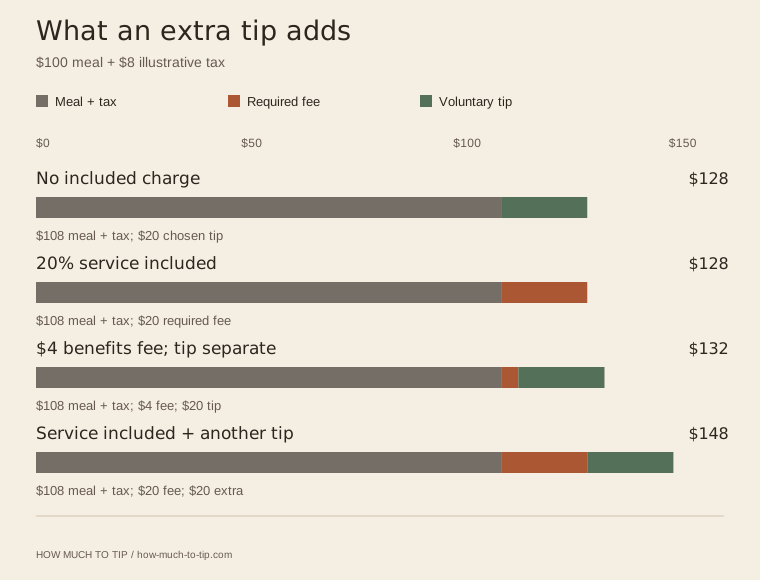
| Illustrative bill | Charge before tip | A reasonable next step |
|---|---|---|
| $100 meal + $8 tax; no included charge | $108 | Choose a voluntary tip. At 20% of the meal, $20 brings payment to $128. |
| $100 meal + $20 service fee + $8 tax; policy says extra tipping is not expected | $128 | Pay the stated bill; another $20 is not the default. |
| $100 meal + $4 benefits fee + $8 tax; policy says fee does not replace tips | $112 | Consider a normal voluntary tip. A $20 choice brings payment to $132. |
| $100 meal + $18 automatic gratuity + $8 tax; additional tipping optional | $126 | The charge is already included. An extra $2, if you want to leave it, brings payment to $128. |
In the last row, the 18% automatic gratuity has already been added. You might leave another $2 to reach a combined $20 for service, but you do not need to add a fresh 20% on top of the $126 total. That would add $25.20 and bring the payment to $151.20.
The fee has no explanation
Point to the line and use the question above. If staff cannot explain an unfamiliar charge, have a manager identify it before payment. For a fee missing from the menu or booking terms, ask for the disclosure or a corrected bill rather than subtracting it yourself.
You want to add something anyway
At that same dinner, suppose the group leaves another $5 because the server was especially helpful. Write $5 on the additional-tip line and $133 on the total line. If the group splits equally, that is $33.25 each.
A benefits fee is added, but customary tipping remains separate
A benefits fee can be much smaller than a customary tip. In the third bill, $4 goes toward a stated staff expense and the restaurant says tipping remains separate. A chosen $20 tip on the $100 meal brings payment to $132. The itemized bill should show both amounts.
A large-party charge is already on the bill
For a large-party charge, check which items the menu says it covers. In an original example, an 18% charge on $100 of food and $50 of drinks is $27. If the stated charge applies only to food, it is $18. Compare the itemized amount with the terms you were given.
Check the headcount too. If the menu says the charge starts at six guests and your table has four, point that out before settling the bill. For a party split across several checks, clarify whether the rule applies to the whole reservation. A separate check may still belong to a large party.
What “automatic gratuity” and “service charge” mean
| Receipt wording | What to check | How to use the answer |
|---|---|---|
| Automatic gratuity / mandatory service charge | Is service covered? Is additional tipping optional? | If service is covered, another full tip is not the default. |
| Staff benefits / wellness / kitchen surcharge | What does it fund, and does it replace normal tipping? | If tips are separate, choose any voluntary tip separately. |
| Suggested tip: 18%, 20%, 25% | Is this a suggestion or a charge already added? | Choose your own amount if it is a suggestion. |
| Service included / no tipping | Does the receipt agree with the menu? | If they conflict, ask staff before adding a tip. |
Under federal wage rules, a compulsory service charge is treated differently from a voluntary tip. Money distributed from the charge is wages. The IRS likewise treats an imposed “automatic gratuity” as a service charge, regardless of its name on the receipt.
An added charge or a suggested amount?
IRS Revenue Ruling 2012-18 illustrates this with two restaurant bills. One imposes an 18% large-party charge. The other leaves a blank tip line and prints suggested amounts. Customers control the second payment and can leave a different amount or none; the first is imposed by the restaurant.
On your receipt, check whether the amount is already included in the total. A row of percentage suggestions beneath a signature line may be showing possible amounts rather than money already charged. An entry called “gratuity” inside the itemized total may instead be required. If you cannot tell which it is, ask before writing another number.
Distribution is a separate policy
The IRS’s current guidance treats required service charges as business income, whether all, some or none is distributed to employees; distributed amounts are wages. That tax classification is not a promise about who receives a particular fee. Applicable state rules and the venue’s commitments can also matter.
El Gaucho: a charge retained by the restaurant
El Gaucho Portland’s menu says it adds a 20% service charge, retains the charge and pays servers commissions separately. It also states that extra gratuity is not expected. Reading only the retention sentence would miss the instruction that answers the diner’s payment question.
The restaurant group’s explanation describes a 15% sales commission for servers and bartenders. It also says an optional extra tip goes entirely to the server. Those are the group’s published terms; they give more useful information than assuming every restaurant distributes its service charge in the same way.
Zazie: service built into menu prices
Zazie’s menu takes another approach: its listed prices include employee revenue sharing and benefits, and it says no tips are expected. The guest does not have to add a service percentage to create that compensation arrangement. Its menu price already incorporates the model.
When comparing menus, add any required service charge before comparing prices. A hypothetical $50 meal with a 20% charge costs $60 before tax. A $60 meal with service already included costs the same. Neither amount comes from the two restaurants’ menus; it is a simple way to compare the billing methods.
Check the final amount before paying
After checking the service policy, compare the bill with any discount, deposit or payment already made. These can change what you still owe even when the service charge itself is correct.
If you choose to add a tip, check its base too. On a $100 meal with a $20 fee, 20% of the meal is $20; 20% of the meal plus fee is $24. Our before-or-after-tax guide shows how to read the suggested amounts.
When the menu and receipt disagree
Point to the discrepancy: “The booking confirmation says an 18% charge, but the bill shows 20%. Can you check it?” Have the restaurant issue the corrected total before you sign, including any tax affected by the adjustment.
If the venue changes the amount, read the updated bill before paying. With our $100 meal and fixed illustrative $8 tax line, replacing an erroneous $20 fee with the stated $18 fee changes $128 to $126. In an actual receipt, a tax adjustment might also be needed. Use the corrected total supplied by the business instead of copying the simplified subtraction.
Coupons and deposits on the same bill
If a coupon reduces a $100 meal to $80, a 20% charge could be $16 on the discounted price or $20 on the original price, depending on the stated terms. Find the discount and the charge as separate entries. The tax and discount guide covers voluntary tips; a restaurant’s required fee must be checked against its own policy.
A reservation deposit can sit on the same paperwork as a service charge, but it does not necessarily pay for service. Read whether it is credited toward the meal, retained as a separate booking cost, or handled another way. If a $50 deposit is credited toward our $128 service-included bill, $78 remains. The deposit has reduced the balance, not removed the $20 fee from the original charge.
For an event contract, find the food-and-drink price, service charge, any separate gratuity and the deposit credit before agreeing to the package. If the paperwork says a gratuity is required, clarify it with the venue before signing. Ask for a written total showing what you will owe after the deposit is applied.
Cash, cards and the extra-tip field
If you have already left an optional $10 in cash, tell staff before filling in the card receipt. On our $128 service-included bill, charging $128 to the card and leaving $10 cash means you pay $138 overall. Charging $138 and also leaving the cash would pay $148, including two extra ten-dollar amounts. A cash payment does not automatically update what the terminal shows.
For a split payment, agree on the combined total first. Two cards covering $64 each pay our $128 bill in full. If each person adds $10, the restaurant receives $148. Keep the merchant receipt’s extra-tip and total lines consistent with the amounts you agreed, and retain your copy.
What happens to a voluntary extra tip?
Voluntary tips have different protections. Under DOL Fact Sheet #15, employers cannot keep employees’ tips, and managers cannot take them through a tip pool. A manager may keep a tip for service they directly and solely provide. Valid tip pools can distribute tips among eligible workers, so a voluntary tip is not necessarily retained entirely by one server.
A delivery fee is a separate question
At delivery checkout, look for the driver-tip line separately. Check whether it is included, adjustable or still to be added; the delivery fee alone does not tell you what the driver receives.
The pizza delivery and DoorDash guides cover driver tips. If you pick the food up yourself, there is no driver to tip. Emily Post says ordinary takeout has no tipping obligation and suggests 10% for extra curbside service or a large, complicated order.
In an illustrative checkout, $40 of food, a $7 delivery fee and $3.20 tax make $50.20 before any voluntary driver tip. If you choose another $6, the payment is $56.20. The $7 and $6 are separate entries; their names alone do not show the driver’s complete compensation. Check the business or platform’s own description rather than applying a restaurant’s service-included policy to a delivery order.
For delivered catering, a service charge might cover transport, setup, staffed service or a combination. Match it to the tasks in the booking agreement. A drop-off tray order and a staffed reception should not inherit the same tipping decision merely because both invoices use “service fee.”
The printable sheet separates charge labels, four sample bills and the questions to ask. The CSV gives you the numerical examples with each optional tip shown separately.
Sources
Restaurant policies, IRS and DOL guidance, and Emily Post’s pickup advice checked October 7, 2026. The original bills use a simplified $8 tax line to compare payment totals; actual tax may also apply to fees. Use the tax on your receipt. A service charge’s federal tax classification does not settle whether a specific fee was properly disclosed under state or local rules.
- El Gaucho Portland menu and Fire & Vine service-charge explanation: a required charge, separate commissions and optional extra gratuity.
- Zazie menus: service-inclusive prices, employee benefits and no expected tip.
- IRS: Tip recordkeeping and reporting: voluntary tips, required service charges and distributed amounts.
- IRS Revenue Ruling 2012-18, Q1: customer-choice factors and examples of compulsory charges versus suggested tips.
- DOL: current official Fact Sheet #15: employee tip protections, valid pools and service-charge compensation.